slavonian and baranja kulen: how they differ and how to spot the real thing
Only two kulen sausages have EU protection. What their official specifications require, why the Baranja one has pepper, and what that means when you buy kulen in winter.
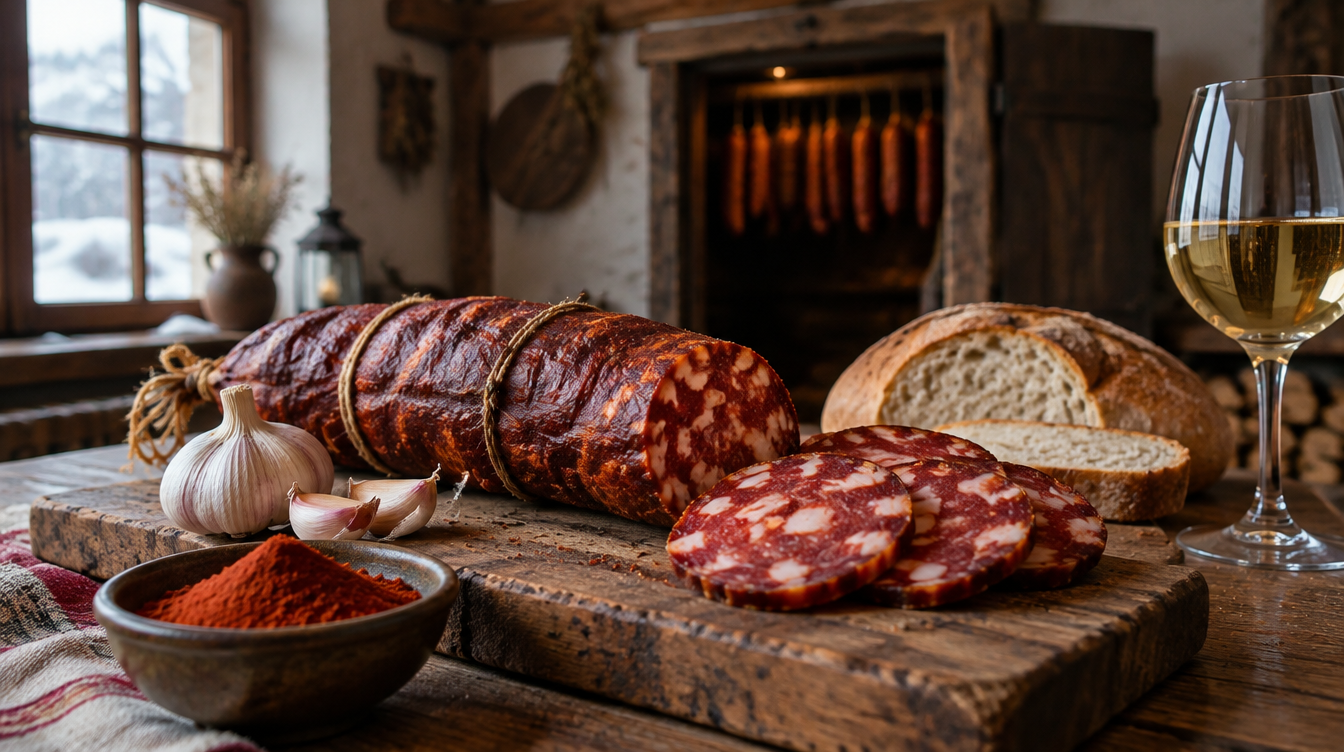
Travel to eastern Croatia and you will see kulen (a thick, paprika-spiced cured sausage) everywhere: at markets, butchers, fairs and on your host''s table. Yet only two names are protected across the European Union as geographical indications: Slavonski kulen (also Slavonski kulin, Slavonian kulen) and Baranjski kulen (Baranja kulen). What may carry those names is set out in product specifications published by the Croatian Ministry of Agriculture.
what kulen is
Kulen is a dry, fermented sausage made from chopped pork and a little hard back fat, seasoned with red paprika and garlic. It is stuffed into the pig''s caecum (a short, wide section of intestine), which is why it is thick and irregular in shape, tied tightly with string. Cut it open and you get a red-and-white mosaic of meat and fat. It is cold-smoked, then dried and matured for months.
slavonian vs baranja: what the specifications say
| Slavonski kulen / kulin | Baranjski kulen | |
|---|---|---|
| Where it is made | listed towns and municipalities of Slavonia, across seven counties | the Croatian part of Baranja (Beli Manastir and eight municipalities) |
| Seasoning | salt, hot and sweet paprika, garlic | salt, sweet and hot paprika, garlic, white pepper |
| Pigs | born and fattened within the production area | pork need not come from Baranja farms, but all processing must happen in Baranja |
| Smoking | cold smoke from hornbeam, ash or beech | cold smoking |
| Minimum production time | 150 days from stuffing | at least 90 days |
| Minimum weight | 900 g | 0.80 kg |
According to its specification, white pepper is exactly what sets Baranja kulen apart from kulen made elsewhere. Slavonian kulen, on the other hand, may only be made between 1 November and 31 March, the time of the traditional winter pig slaughter (svinjokolja).
what this means when you buy
Slavonian kulen stuffed this winter needs at least 150 days to mature, so it is ready in spring at the earliest. If you buy it in December or January, you are buying last season''s kulen, the batch that has finished maturing.
The Slavonian specification also notes that the meat industry makes similar-looking sausages under other names, usually from intensively farmed pigs, sometimes with beef and additives. The word "kulen" on a label does not, on its own, mean the protected product.
In Slavonia, kulen is kept for holidays and family celebrations and is a common gift. If you are spending the holidays in Croatia, see also what Croatians eat at Christmas, and for autumn our guide to St Martin''s Day and new wine.
tips
- Check the label for the exact name: "Slavonski kulen", "Slavonski kulin" or "Baranjski kulen". Only kulen made to the specification may use it.
- Look at the cut surface: meat and fat should be well bound, with no holes or cracks.
- Kulen should be firm. For Baranja kulen, the specification says it must not bend when pressed from both ends.
- Expect different flavours: Slavonian is salty and hot, Baranja mildly hot with a note of pepper.
- Baranja kulen may be sold whole or sliced, so ask the seller which suits you.
If you want to taste kulen where it is made, a stay in Baranja such as Kuća Biljkinog oca in Lug is a good starting point.
Sources:
Ministry of Agriculture: Product specification Slavonski kulen / Slavonski kulin · Ministry of Agriculture: Product specification Baranjski kulen · Ministry of Agriculture: Register of protected names.docx) · European Commission Representation in Croatia: Slavonski kulen joins EU protected names